Although my PhD thesis has been available for several years through the Massey University library webpage, I have not made it directly available myself. Since I have, however, now used some of this research in published articles, and am unlikely to turn it into a fully-fledged book for some time, I have decided to post a PDF copy here – in order to make the ideas and arguments more widely available.
(Obviously, if ideas/arguments/content from this thesis are used, please cite in the standard fashion. Ngā mihi.)
Samuel D. Carpenter, ‘The reshaping of political communities in New Zealand : a study of intellectual and imperial texts in context, c. 1814-1863’, PhD thesis, Massey University, 2020.
Abstract
This thesis explores transformations in British and Māori political thought and mentalities through the period c. 1814 to 1863 – from the arrival in New Zealand of Samuel Marsden and the Anglican Church Mission through to the outset of the Waikato wars. It analyses evolving and contested political languages in British metropole and empire, particularly concerning the nature and bounds of British national and imperial community and government. It considers the attempts by Britons, from Marsden, through Busby, then the Church Mission presses to encourage the formation of a native (Christian) political community, and then to maintain it against the threats posed by British colonization ventures. Political thought about nations or supra-tribal political communities contained in the Māori translations of scripture, prayer book and texts of history, law and geography are the focus of several chapters, as are the uses of these new political languages made by Māori protagonists Hone Heke, Tāmihana Te Rauparaha and Wiremu Tāmehana.
Drawing on literatures of nationalism, the thesis finds that the emergence of Māori national thought or consciousness – an imagined political community of ‘native New Zealand’ – resembled the early-modern emergence of English and other European nationalisms. This study reveals an historical process in which Christian scripture and liturgies in vernacular languages helped to form a wider collective consciousness in England/Europe, and then argues that a similar process occurred throughout indigenous Niu Tireni (New Zealand). Critically, it was the daily and weekly practice of the Anglican Prayer Book – Te Rāwiri – rather than simply its texts or the Bible translations per se, that engendered a new language of politics and a new global knowledge concerning pan-tribal nations, their kingly polities, and their God-ordained relationship with whenua (land).
The thesis therefore re-frames the early political history of New Zealand as a history – or histories – formed by texts variously translated and interpreted, printed and discursively reproduced, read and recited, prayed and sung, and institutionally embodied in native assemblies, legal systems and kingships. It argues that this new textual and discursive world was enabled by the immense diffusion of printed texts, constituted a new indigenous or ‘maori’ public sphere, and generated the imagining of new forms of native or supra-tribal political community. Texts also provoked prominent indigenous actors to ‘write back’ against both colony and empire. The thesis suggests a much larger project to recover and map the diverse political languages and deeper mentalité that shaped the contested terrain of colonialism in New Zealand.
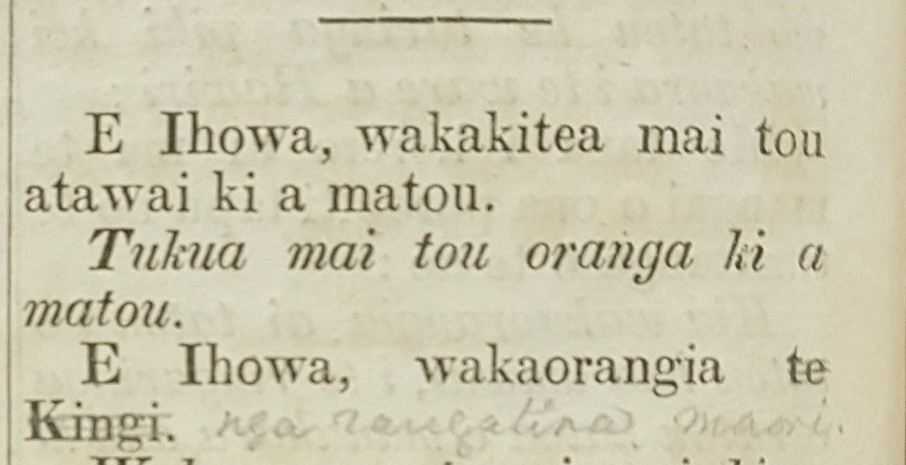
has been changed to ‘O Lord, save the native chiefs’.
The thesis is also available at Massey University online theses.
 Samuel D Carpenter I HOME